


Building environmental superintelligence.
EnviroAI was founded on the belief that the highest form of intelligence protects life. We are building an AI that senses, understands, and protects the living world in real time. The first of it is already at work.
Deployed. Fortune 500 companies run it every day.
Some of the largest industrial and petrochemical companies in the world run EnviroAI every day on their own facilities and permits. It is built in use, with the teams who run it: each release takes on more of the environmental work, and they get the gains as it ships, not at the end. Check the sources before you act; it is built so you can.

“I spent twenty-seven years as an environmental attorney watching good people protect the environment with tools that were too slow. This is the tool I wished I had.”
Jed Anderson, Creator and CEO. His story
Actual product captures
Ask it anything about the environment.
It is tied directly to the environmental record, live Earth data, and the map of every facility in a covered state, and it does the work, not only the answer. Eighty-five seconds of it in use, starting where every day starts, on the main screen.
- Ask
- Answers with sources
- See
- Every emission point, on the map
- Watch
- Outfalls against their limits
- Compare
- Enforcement, plant and company
Ask about the place. It reads the numbers.
One question on a facility's map: which outfall exceeds most, what pollutant, and what to do about it. The answer is written from the agency's own monitoring reports, the permit, and what comparable plants have done, with a dated action table at the end.
- Input
- One question, on the map
- Read
- Twelve months of discharge reports
- Output
- Analysis and an action plan
- Sources
- Cited, agency records
Air dispersion, in context.
A flare's plume over a real plant, hour by hour, in three dimensions, with every school and clinic in range listed.
- Source
- Flare, ethylene
- Worst off-site point
- 4.18 µg/m³
- Share of the Texas screening level
- 0.3 percent
- Receptors screened
- Schools, clinics, homes
One sentence in. A permit package out.
The agent reads the facility's current authorization, drafts the forms and the compliance review, and lists every value it could not confirm for a person to check.
- Input
- One sentence
- Output
- Seven documents
- Unconfirmed values
- Marked, not guessed
- Who signs
- A person
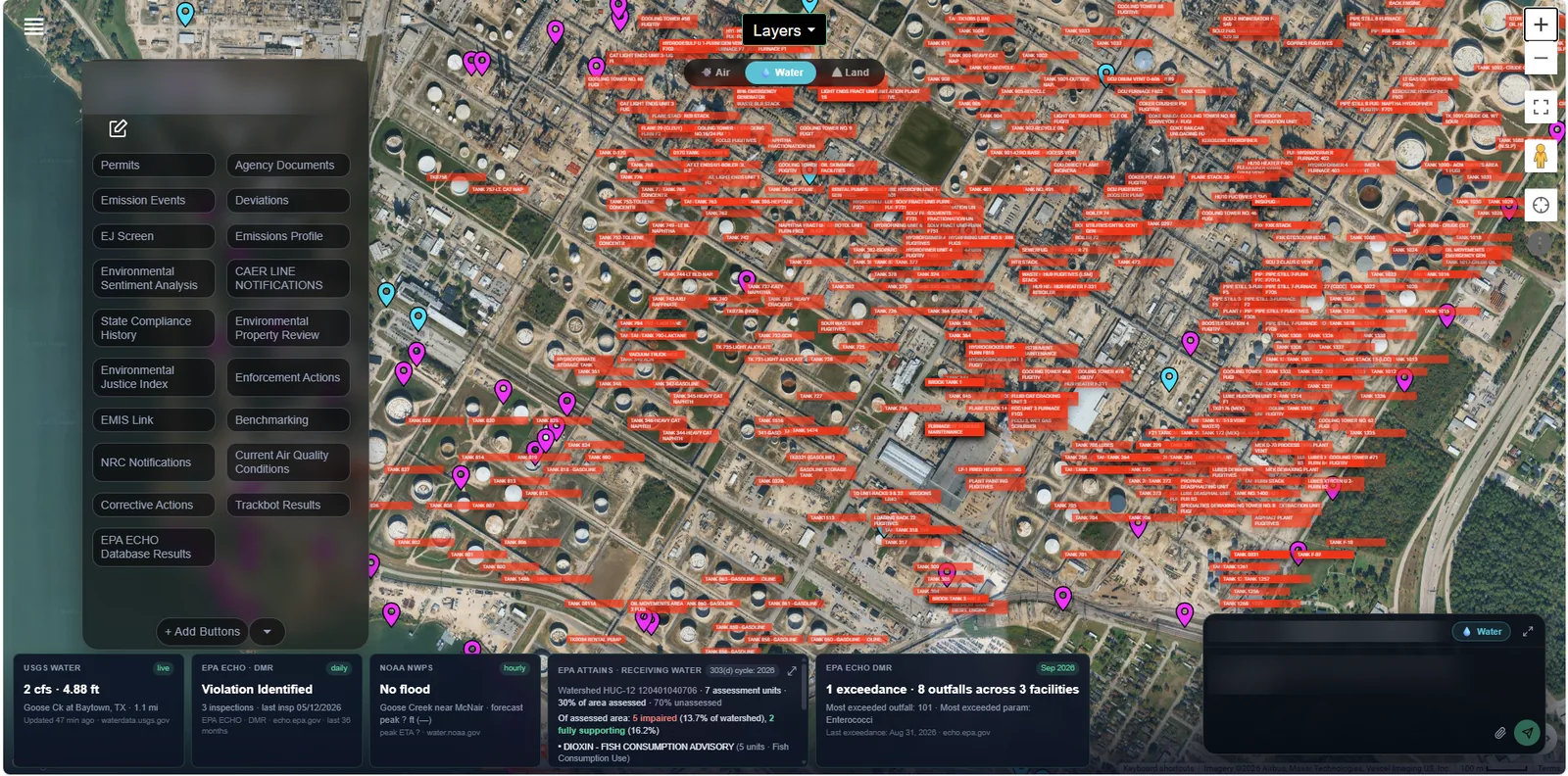
Every emission point, on the map.
A refinery as the system sees it, with live stream flow, flood forecast, watershed status, and discharge records attached to the place.
- Emission points
- 1,188 at one refinery
- Each with
- Its permitted limit
- Live feeds
- Water, weather, enforcement
Nothing arrives as a surprise.
Type a word, pick the agencies, subscribe. Every filing that mentions it lands in the list, with an email alert.
- Agencies
- TCEQ, LDEQ, more
- History kept
- Ninety days
- Alerts
An environmental brain. It reads more every day.
Everything the system answers with lives in one place: the public record, indexed; the live feeds; the geometry of every facility in a covered state; and the models on top. Agencies file new documents every day, and the record is indexed as they file. Next: a model trained to predict environmental conditions from these observations, the Large Environmental Model.
- Documents indexed
- 22,000,000
- permits, agency filings, enforcement records, regulations; about, as of October 2026
- Added each day
- 10,000
- on an average day; indexed as agencies file
- Emission points at one refinery
- 1,188
- on the map, each with the limit its permit sets
Every facility mapped, automated work running: Texas and Louisiana, the other states following.
Agency records in the brain: twenty states and two provinces, more being added.
Agency records in the brain in part: California.
Live feeds the brain also reads, as they update: stream gauges, air monitors, weather stations, enforcement and discharge reports. Every mapped facility is also seen in satellite imagery.
States with records in the brain: Texas, Louisiana, Alabama, Arkansas, California, Connecticut, Florida, Georgia, Iowa, Illinois, Indiana, Kentucky, Michigan, Missouri, Nevada, New York, Ohio, Pennsylvania, Tennessee, Washington; and the provinces of Ontario, Alberta. Coverage and methods.
The record is public. The reading is the work.
Permits, agency filings, enforcement actions, and the rules behind them are public records. Reading them is what environmental lawyers and consultants do by hand, one document at a time. EnviroAI indexes the public record of the agencies it covers and reads it at scale: each document tied to its facility, its emission points, and its permit limits, and kept current as agencies file.
That is why an answer cites the document it came from. Anyone can check it.
Your state not lit yet? The federal rules, which most state programs carry out, are in the brain in full, and much of the equipment and the compliance work is the same from state to state. A state-specific conclusion still needs that state's own sources, which is where coverage grows next.

The plant is where it starts. The living world is what it is for.
Every answer shows its source. A person makes the call.
Care has a speed limit.
Every protection system ever built does the same four jobs: sense what is happening, work out what it means, decide what to do, and act. Before there were rules, harm was answered in decades, if at all. For the last hundred and fifty years it has been answered in years, at the speed of law.
The product above closes the first half of that loop in seconds, at one plant: it senses and it works out what it means, and a person decides and acts, inside limits people set. The climb is closing the whole loop, everywhere.
The climb to environmental superintelligence
EnviroAI measures itself against a mountain. Each camp is a capability that works and is in use before the next one starts.
-
Camp 1 2018
EnviroAI's first environmental AI tool: it took one fifty-hour legal task down to three hours, and the first customer, one of the largest petrochemical companies in the world, signed the same year.
-
Camp 2 2022
A chatbot over the environmental record, launched in December 2022 on top of a search engine across the public environmental record.
-
Camp 3 2025
An environmental permit application package prepared end to end by an AI agent system, in October 2025, with every unconfirmed value marked and people reviewing it before submittal.
-
Next The LEM
The Large Environmental Model in service: predictions of what air, water, and land will do next, tested against measurement, connected to the decisions people are required to make.
-
Summit 2045
Environmental superintelligence: a continuous system that senses, predicts, and helps protect the living world in real time, with people setting the values and the limits.

In development
We have taught AI not to harm. We have not taught it to care.
That is the AI safety question we are missing, and the reason to build a model that learns from the Earth and not only from what people wrote about it. The Large Environmental Model is in development; the first generation is not yet built.

See it on your own facilities.
A demo runs on the public record of a facility you choose. Thirty minutes, no slides.