Notes from the Climb
Field notes from Jed Anderson, Creator and CEO of EnviroAI, on the route toward the summit of environmental superintelligence: what the view looks like from here, what the next pitch requires, and the ideas that will get us there.
Onward. Upward.

“I want everyone to see themselves on this climb.”
Start here
Selected writing.
-
October 21, 2026 Deck
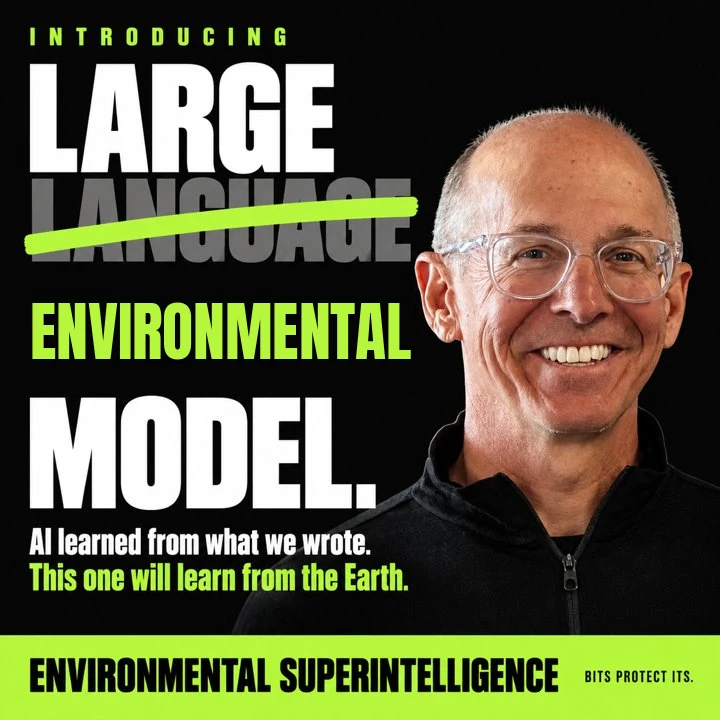
The Large Environmental Model
AI learned from the wrong half of the world, what humans wrote. A model trained on the Earth's living systems and the law that protects them, judged by one test: whether living systems do better. The architecture, an open benchmark, a three-generation build, and the case for starting in Texas.
-

October 9, 2026 Essay
Superintelligence, Grounded in Life
Superintelligence names a level of capability, not a purpose, so the deciding question is: superintelligent at what? A proposal to make protecting life part of how intelligence grows, rather than a constraint bolted on afterward.
-
October 7, 2026 Essay
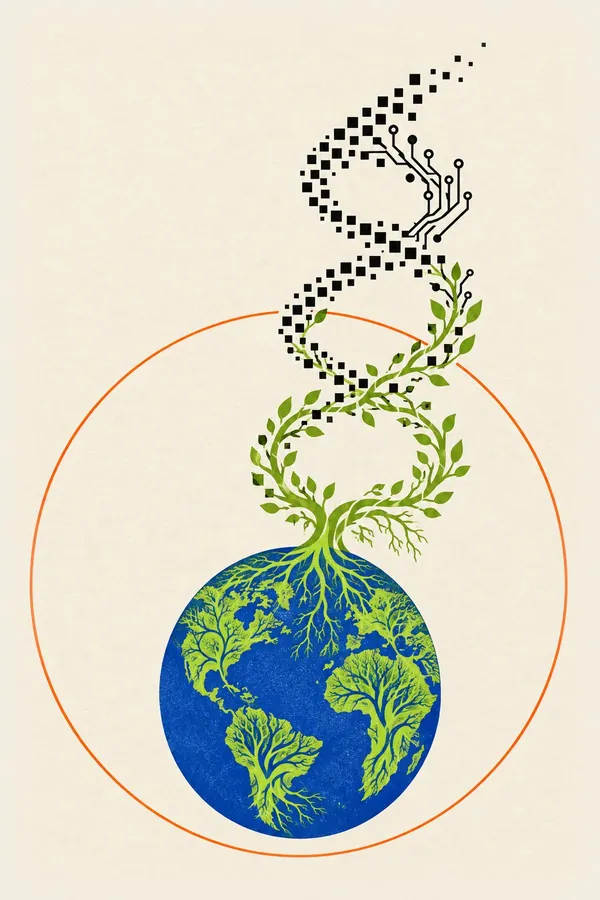
The Planet Is the Benchmark
The call to halt AI's self-improvement gets the peril wrong. The danger is not that intelligence improves itself; it is that it improves against a benchmark nobody can audit. Make the planet the benchmark, and the loop is graded by something that cannot be gamed.
-
September 9, 2026 Essay
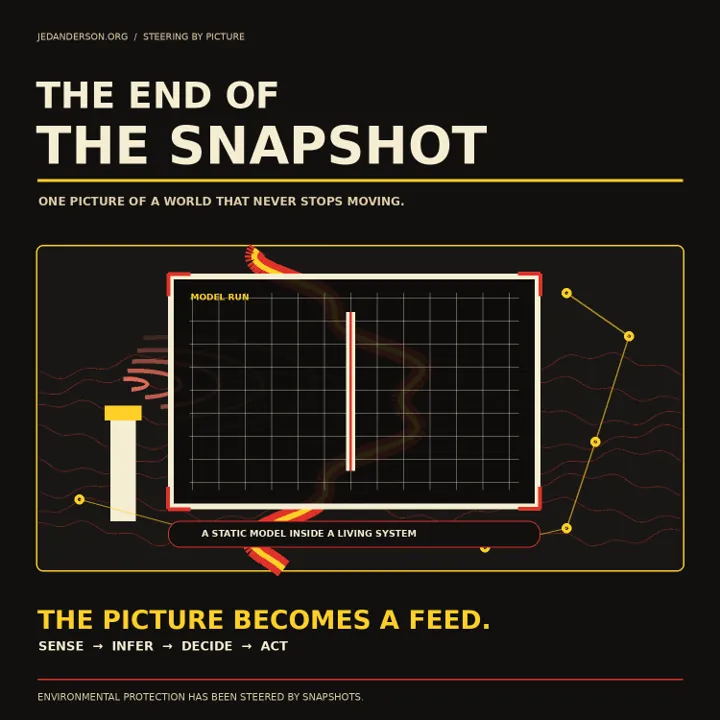
The End of the Snapshot
Environmental permits are written from models run once, on chosen inputs, whose outputs become legal facts for decades. The picture should become a feed: a model that never stops running, inside a loop that senses, infers, decides, and acts.
-
September 9, 2026 Paper
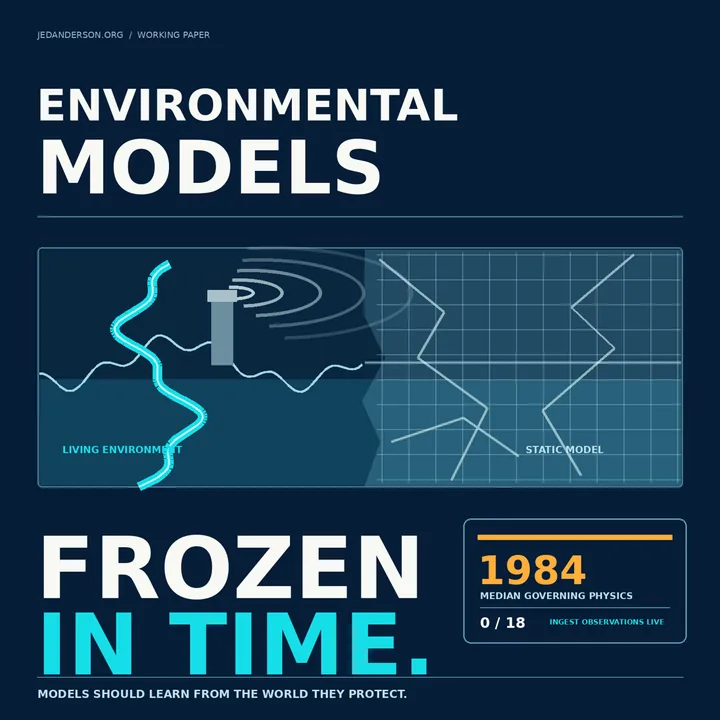
The Frozen Instrument
An inventory of eighteen simulation models in routine use for United States permitting finds a median governing formulation from 1984. The instruments are frozen while the world they regulate moves. Models should learn from the world they protect.
-
September 5, 2026 Paper
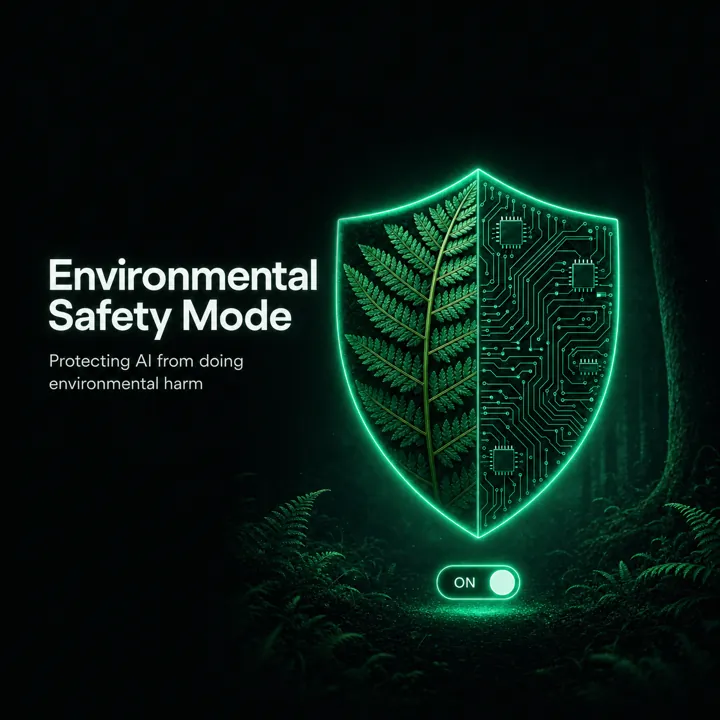
Environmental Safety Mode: The Proxy Stack, the Interlock, and What Physical Grounding Can and Cannot Do
Should AI have an environmental safety mode? When a system chases its task, what keeps it from harming the living world on the way? The technical companion to that question, with sources, uncertainty bands, and a plain account of how each proposed safeguard can fail.
-
August 27, 2026 Essay
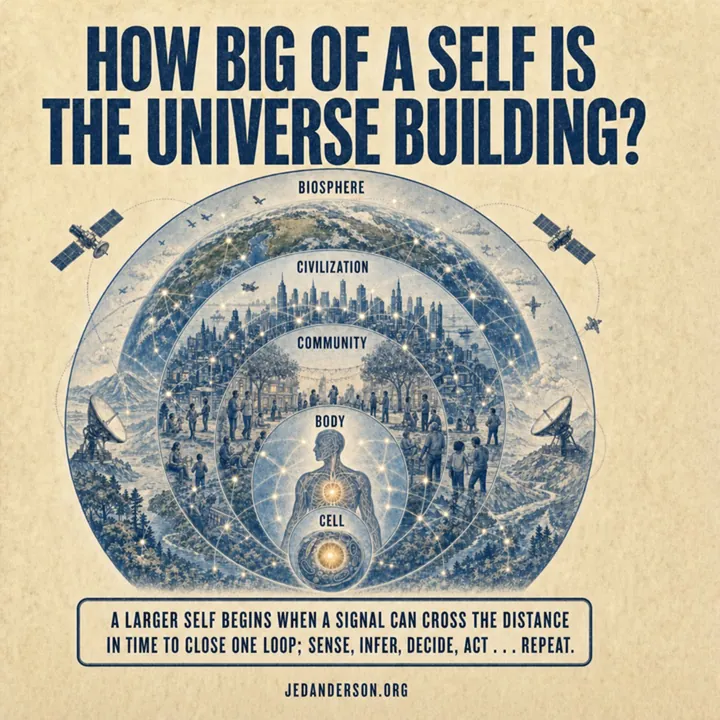
The Law of Larger Selves
A larger self begins when a signal can cross the distance in time to close one loop: sense, infer, decide, act, repeat. Twenty-two words, tested against three and a half billion years of life, and floored on physics: the Earth, in optical fiber, is exactly one reflex wide.
-
August 20, 2026 Paper
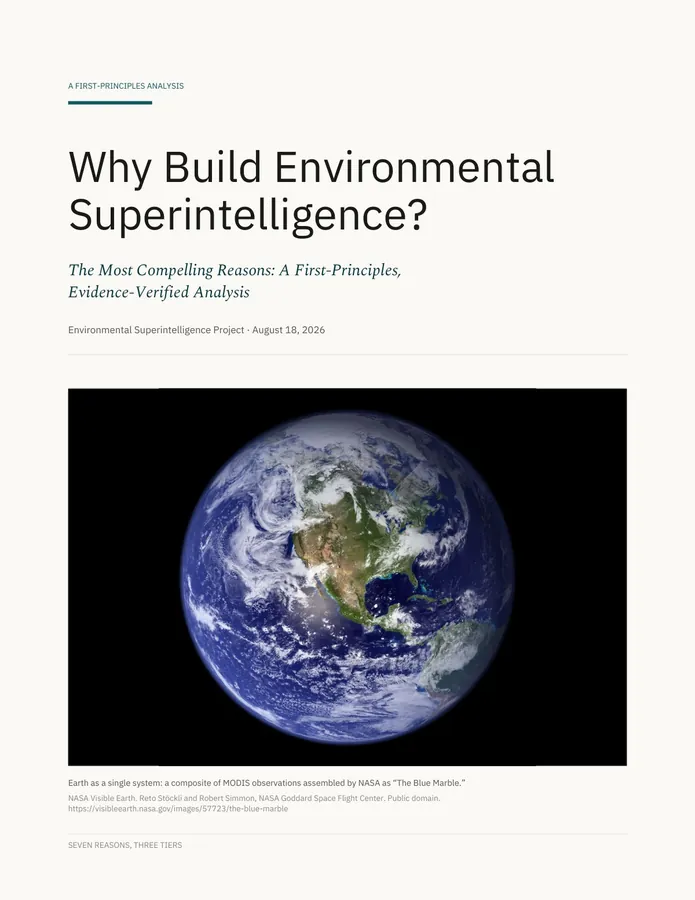
Why Build Environmental Superintelligence?
Candidate reasons generated broadly, tested against the measured state of the world, fact-checked, red-teamed, and ranked. Seven survived, in three tiers, and each says what it does not prove.
-
August 5, 2026 Essay
The Missing Chapter of AI Safety
A word-by-word search of the five safety frameworks the largest AI companies published for their own models for watershed, aquifer, habitat, species, and ecosystem. The report on what was not there.
-
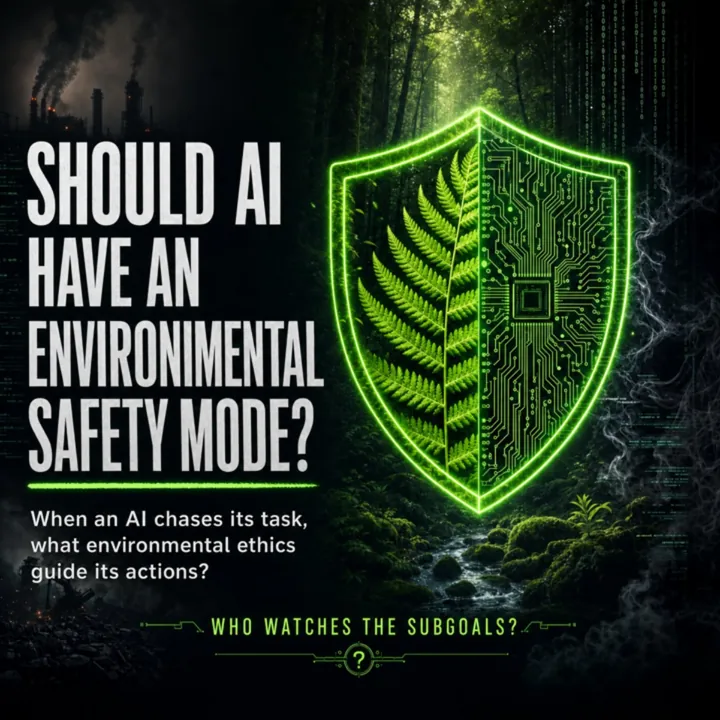
August 4, 2026 Essay
Nature-Aligned AI
The environmental risk of AI has been misidentified. Data center electricity and water are a bounded cost. The real risk is an intelligence with no model of the living world, acting on it anyway. First mention of the Large Environmental Model.
-
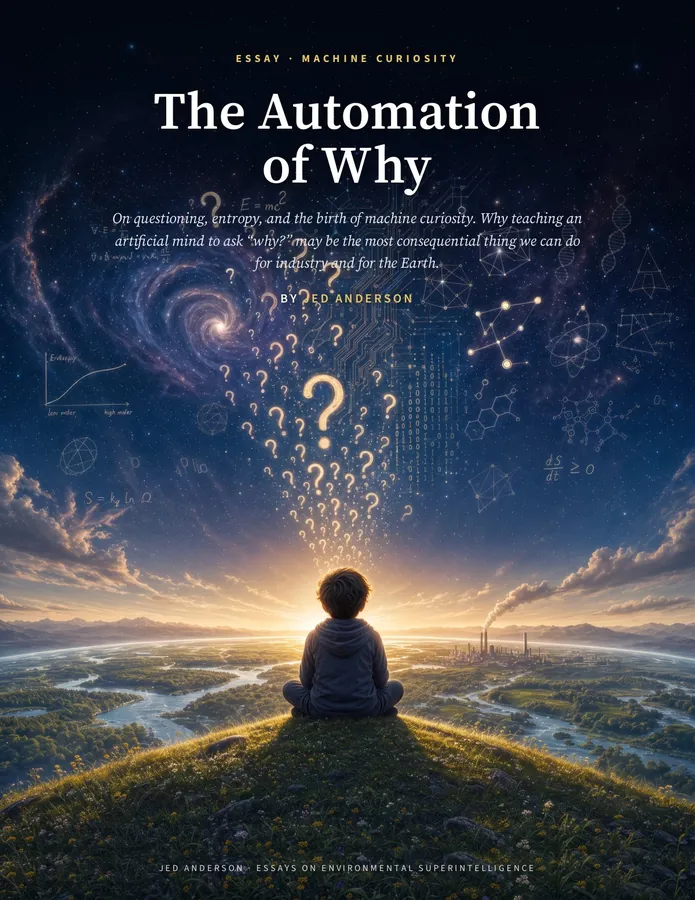
July 24, 2026 Essay
The Automation of Why
Answers are now cheap. The scarce resource is the curiosity to ask and the wisdom to ask well. A case for machines that generate the questions, and a sketch of one that does.
-
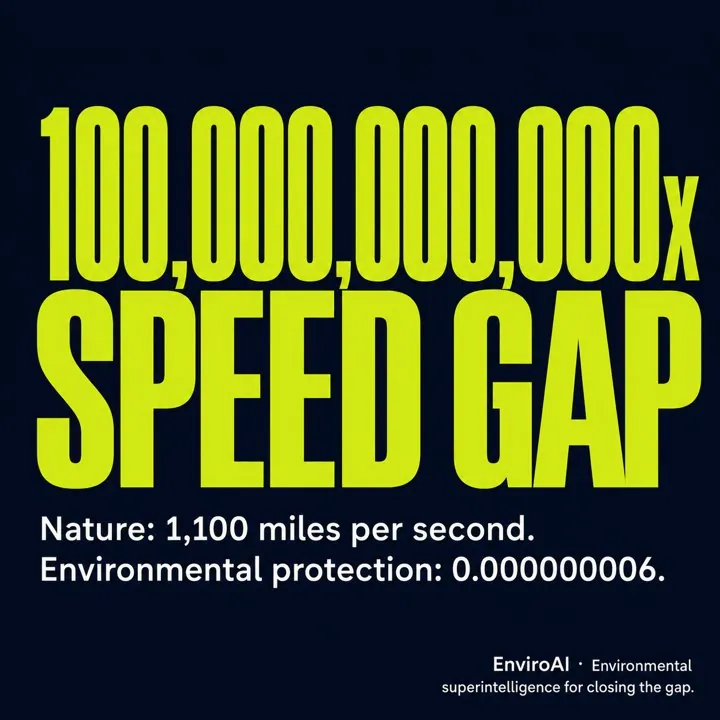
July 20, 2026 Paper
Planetary Dead Time: Overcoming the Hundred-Billion-Fold Control Gap in Environmental Stewardship
Every instance of environmental harm runs a control loop: sense, transmit, understand, decide, act. Nature's loop closes in milliseconds; environmental protection's closes in years. The hundred-billion-fold gap, and how to close it.
-
June 25, 2026 Essay
Nature Computes
Ten exercises, each taking under ten seconds, that make one shift in perception visible fast: nature computes. We compute. Compute together.
-
June 19, 2026 Essay
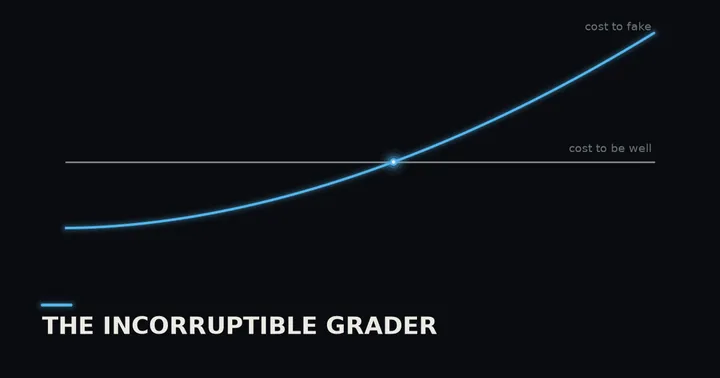
Reality as the Only Incorruptible Grader
Any objective you can specify gets gamed. The one grader that cannot be fooled is reality: measured outcomes in the physical world. Why an AI pointed at the living world is safer than one pointed at a score.
-
June 18, 2026 Essay
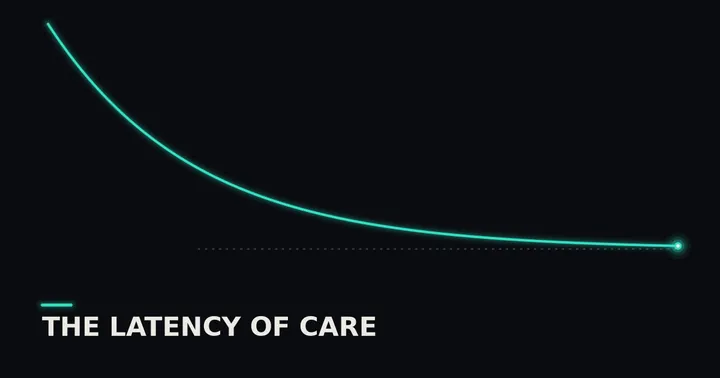
The Latency of Care
Every failure to protect the biosphere has been a latency failure: dead time in the loop between when a living system began to suffer and when anyone acted. Care has a speed limit, and it can be raised.
-
June 17, 2026 Definition
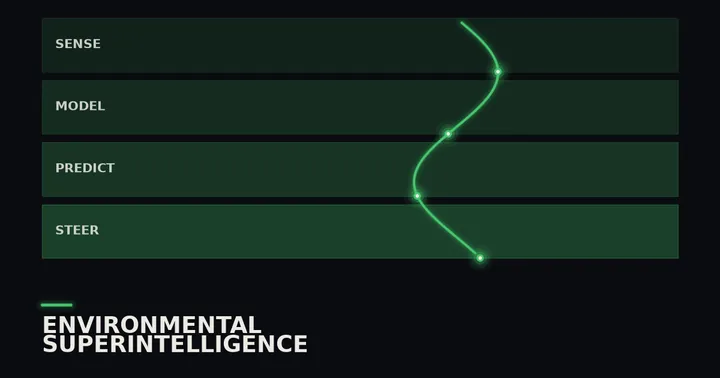
Environmental Superintelligence
The definition the mission rests on: a continuous, physics-grounded information infrastructure that protects the biosphere by sensing, modeling, predicting, and stabilizing Earth's systems in real time. Human-wielded and protective, never a successor.
-
June 14, 2026 Essay
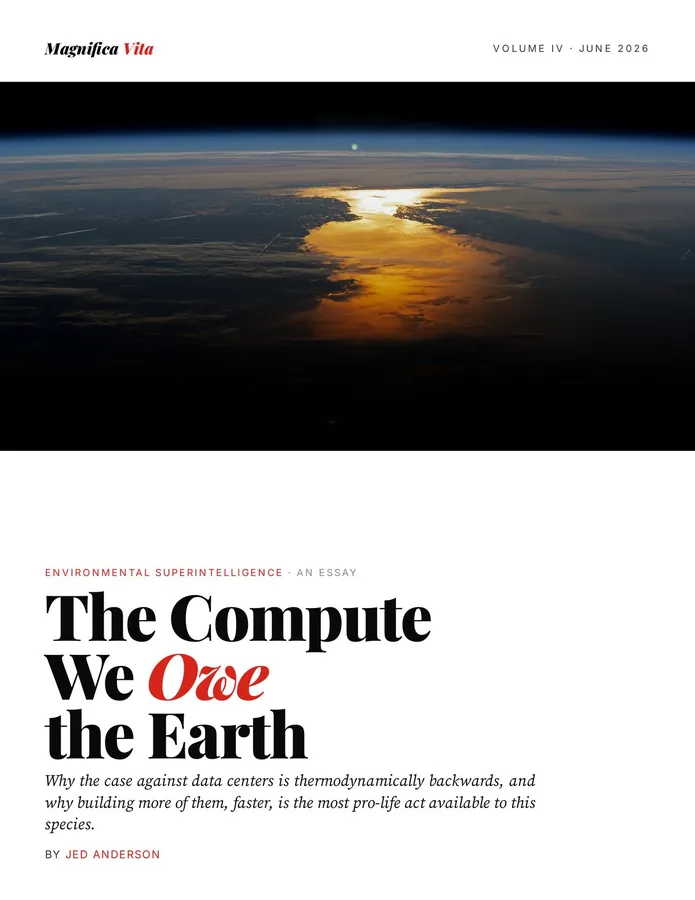
The Compute We Owe the Earth
The environmental case against data centers is backwards. Because knowing is cheaper than moving, the compute that protects the Earth pays for itself many times over. The question is not whether to build it, but how much of it we owe.
-
May 22, 2026 Essay
Bits Protect Its
The full treatise behind the thesis. Walks the decades-long loop from a health finding to a facility emitting less, the physics of information, and the inversion that follows: environmental law was always a stand-in for a cognitive limit, and the organ it substituted for is now being built.
-
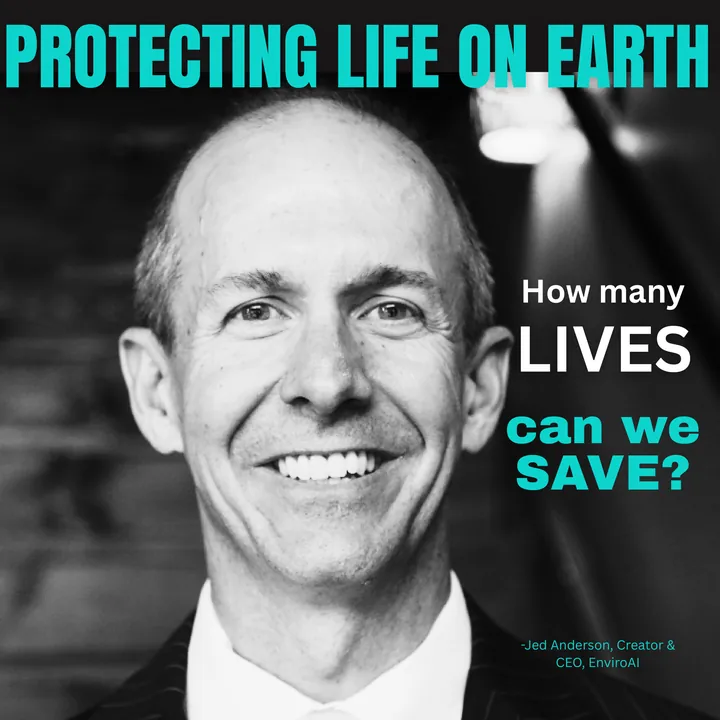
May 13, 2026 Deck
Protecting Life on Earth: How Many Lives Can We Save?
The mission in human terms: how many lives can a sensor-equipped, AI-coordinated environmental protection system save? A deck.
-
May 12, 2026 Essay
A Walk You've Never Taken
Twelve verified physics observations, each taking ten seconds on a thirty-minute walk, ending at the reason information is the cheapest way to protect anything.
-
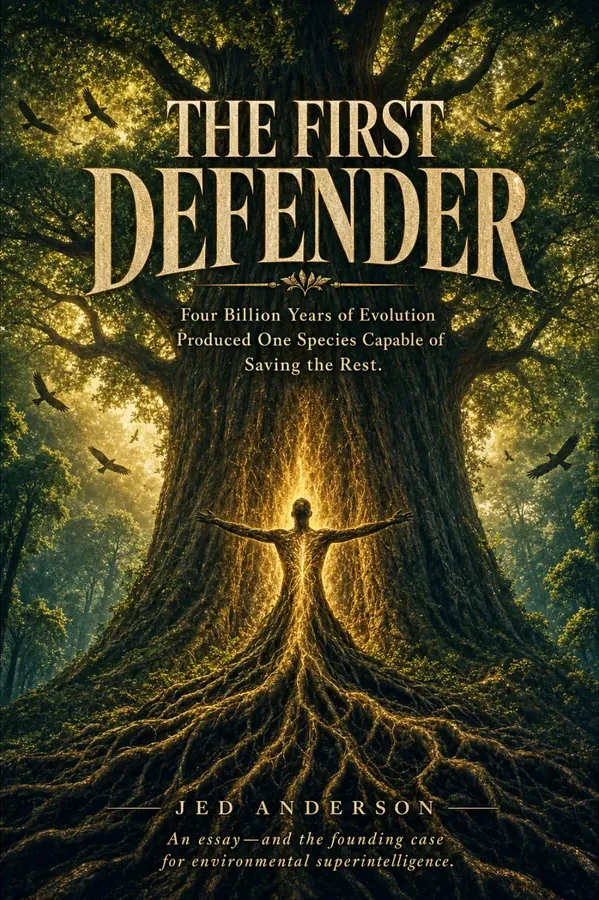
May 9, 2026 Essay
The First Defender
The founding case. Four billion years of evolution produced one species capable of saving the rest. The species that built fossil-fuel infrastructure is also the only one that has ever solved a planetary problem.
More writing.
-
October 24, 2026 Deck
Texas: One Percent for the Living WorldWhat do data centers owe Texas? Not money but computing. Every data center in the state would pledge one percent of its compute to a model that learns the Texas environment, and the Large Environmental Model gets its first home.
-
October 9, 2026 Brief
A Paradigm Shift in AI SafetyA one-page strategy brief: let AI improve its own methods only in ways that measurably protect living systems, and test the claim. A proposed, checkable contribution to AI safety.
-
October 7, 2026 Essay
Recursive Environmental Self-ImprovementAI has begun to improve the process that builds AI. The deciding question is no longer whether intelligence recurses, but what it recurses toward. A case for pointing the loop at the living world.
-
October 7, 2026 Essay
The Guard and the GardenerModern environmental institutions cast us as a guard keeping harm out of the garden. Sensors, networks, and AI could let us become the gardener instead. One page, no physics required.
-
September 3, 2026 Essay
Ouch.Environmental law is the sound a civilization makes after the burn: ouch, without the flinch. Why the Earth has never had a reflex, and what it takes to give it one.
-
August 22, 2026 Essay
Who closes the environmental protection loop?Seven eras of the protection loop, from a thermostat with no one to set it to a valve that shuts the second a leak opens. Every era does the same four jobs. Only the speed has changed.
-
July 24, 2026 Definition
Environmental IntelligenceThe base of the ladder: the capacity to convert the state of the physical environment into understanding precise enough, and timely enough, to act on. Above it sit environmental AI and environmental superintelligence.
-
May 24, 2026 Essay
The ArcA twenty-seven-year path through environmental law to the realization that environmental protection is not a legal problem but an information problem, and the work of building what comes next.
-
May 13, 2026 Essay
The Environmental Superintelligence ManifestoThe originating statement, written at the turn from two decades of Clean Air Act reform toward the information-physics framing that anchors everything since.
-
April 18, 2026 Essay
Bit Protect ItThe thesis in plain prose, for anyone who loves the Earth: knowing is cheaper than moving, by a factor that grows every year, and that gap is the physical foundation of protecting the living world.
Selected from Jed Anderson's writing at jedanderson.org, where the full text lives under a Creative Commons license. The wider corpus, on information physics and more, is there too.